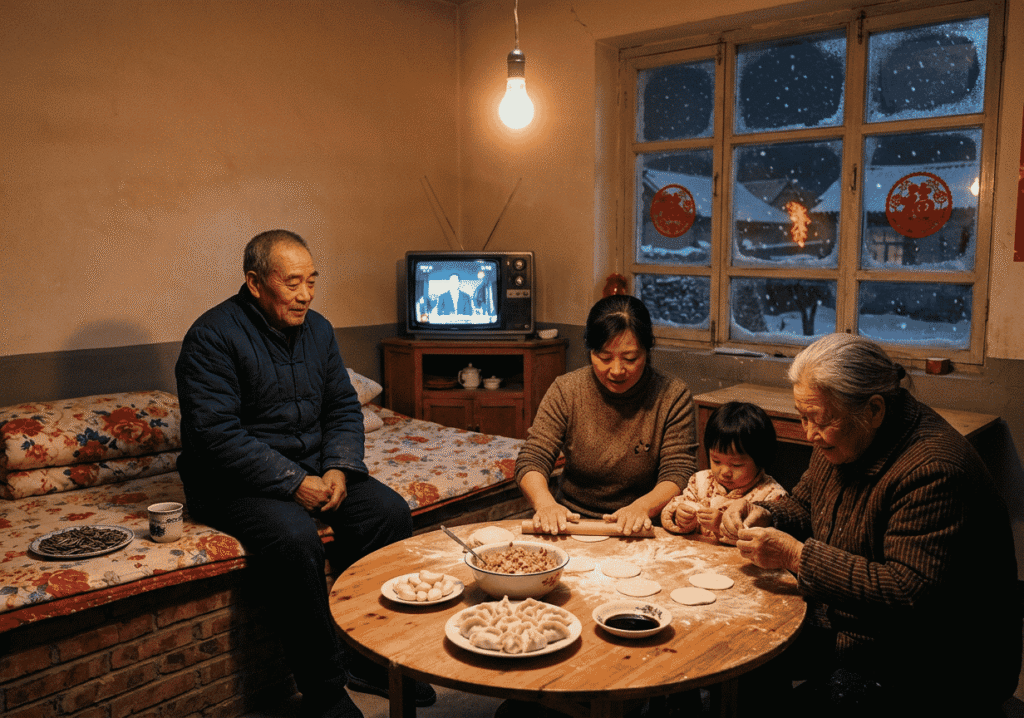
The first thing I remember about Chinese New Year is the cold.
Not the cold itself — the sound of cold. Silent winter mornings in a Shandong village, frost painting white patterns on the window glass, the whole world holding its breath. And then, somewhere far off, a single firecracker pops. Then another. Then a whole string of them, crackling like the village is waking up to something important.
Spring Festival (春节, Chūnjié) is the biggest holiday on the Chinese calendar. Bigger than any national holiday you can name. For centuries, it has been the one time of year when every Chinese person — no matter how far they’ve wandered — tries to come home.
But here’s the thing: Chinese New Year today doesn’t feel the way it did thirty years ago.
I want to tell you what it felt like back then. And what’s changed. And the few things that, somehow, haven’t changed at all.
Before we get to memories, there’s a story worth knowing.
A long time ago — nobody agrees exactly how long — there was a monster called Nian (年兽, Niánshòu). It lived in the mountains or the sea, depending on who’s telling the story, and once a year it would come down to the villages and eat people’s livestock. Sometimes eat people. Not great.
Over time, villagers figured out three things Nian couldn’t stand: the color red, bright light, and loud noises.
So at the end of each lunar year, families started hanging red banners on their doors, lighting torches, and throwing bamboo into fires so it would explode with a loud crack. They stayed up all night, waiting for dawn, waiting to see if they’d survived another year.
That night became 除夕 (Chúxī) — New Year’s Eve. The characters literally mean “the evening of getting rid of the old year.” You’re not just celebrating. You’re defeating something. Passing through a dangerous gate into a new beginning.
This idea — that the new year must be won, not just waited for — runs through everything that follows.
If you grew up in a Chinese village in the 1980s or early 90s, New Year wasn’t a holiday. It was the entire point of winter.
Once the twelfth lunar month (腊月, Làyuè) arrived, my grandparents shifted into a different gear. Grandma would tie a cloth around her head and sweep every corner of the house. You couldn’t just clean; you had to sweep out the old year’s bad luck. Grandpa would walk to the market town and come back carrying sacks of sunflower seeds, rock sugar, dried dates, cuts of pork wrapped in old newspaper.
In the evenings, the neighbors gathered in someone’s kang-warmed room, cutting red paper into window flowers (窗花, chuānghuā) — fish for abundance, peonies for wealth, the character 福 (fú, “good fortune”) pasted upside down because “fortune arrives” sounds exactly like “fortune upside-down.”
Nobody was in a hurry. The whole month was one long preparation.
For kids, Chinese New Year was the absolute ceiling of happiness.
You got new clothes (新衣服, xīn yīfú) — maybe just a cotton jacket a size too big so you’d grow into it, but it was new. No patches. No hand-me-down smell from a cousin.
Your pockets were full of those tiny single-firecrackers — the ones that came individually, not in rolls. You’d hold one in your left hand, light the fuse with a stick of incense in your right, wait exactly the right amount of time, and throw it. Sometimes you miscalculated. That was part of it.
And for one or two weeks, nobody made you do homework.
Getting home for New Year in 1980s China was a genuine ordeal. Green trains so packed you couldn’t sit down. Bus stations where three hundred people fought for a spot on a bus built for fifty. The last leg of the journey might be on the back of a tractor, bouncing down frozen dirt roads.
And everyone did it anyway.
That single fact tells you more about Chinese New Year than any description of customs: everyone went home. No exceptions. The reward at the end was a family crammed around a low table, the room lit by a single bare lightbulb, a small TV broadcasting the CCTV Spring Festival Gala, and everyone folding dumplings together.
You’d watch the TV. You’d chat. Sometimes you’d just sit there, full and warm, listening to the adults gossip about who had come back from the city and who hadn’t.
That was it. That was everything.
Today, I can walk to a supermarket and buy dumplings any Tuesday evening in June. In the 1980s countryside, you couldn’t.
That’s the difference that explains everything about why festival food used to taste different.
The pig. In farming villages, families raised one or two pigs all year. Sometime before New Year, you’d slaughter one. A whole community event. The smell of braised pork and deep-fried meatballs drifted through the alleyways for days. For kids who had eaten mostly vegetables and rice all year, this was paradise.
The dumplings (饺子, Jiǎozi). On New Year’s Eve in the north, everyone made dumplings from scratch. The dough. The filling — usually sour cabbage and pork. And hidden inside a few of them: a cleaned coin. Bite into the wrong one and you’d chip a tooth. Bite into the right one and you’d have good luck for the entire coming year.
The sweets. Rock candy. Hawthorn flakes. Roasted peanuts from the wok. And those fruit-shaped hard candies that showed up only when relatives came visiting. The ones you’d suck slowly, making each one last ten minutes, because who knew when you’d get another.
None of this was extravagant by today’s standards. It just felt that way because you couldn’t have it any other day.
On the first morning of the new year (大年初一, Dànián Chūyī), you woke up before dawn. You put on your newest clothes. You ate the first bowl of freshly boiled dumplings.
Then came the part that would feel most foreign to a modern outsider: kowtowing (磕头, Kētóu).
In the main room, you’d kneel on the floor in front of your grandparents, then your parents. Hands on the ground. Forehead to the floor. You’d say something formal, like “Grandma, your grandson wishes you health and long life.” And you meant it.
This wasn’t humiliation. It was gratitude — made physical. You were acknowledging, with your whole body, that these people had fed you and raised you and sacrificed for you. One bow a year. It was the least you could do.
Then came the red envelope (压岁钱, Yāsuìqián). The characters literally mean “money to suppress the passing year” — the idea being that giving coins to children would ward off evil spirits and help them grow another year older safely.
In the 1980s, a red envelope might contain fifty cents. Or one yuan. A generous one held five yuan. That was a fortune. That was your entire year’s pocket money.
After the family kowtows, the young men of the village would form groups and walk from house to house, bowing to every elder in the community. It was social infrastructure. You knew which families were feuding and which had newborn children. The whole village was accounted for.
No description of Chinese New Year works without firecrackers.
They started at midnight on New Year’s Eve — the “opening-door firecrackers” (开门炮, kāimén pào) that blasted away the old year. They started again at dawn on New Year’s Day, welcoming the new one.
You couldn’t hear yourself think. Not just one family lighting a string — the entire village, the entire region, the entire country, all at once. The noise didn’t stop for hours.
Afterward, the ground was carpeted in red paper shreds. Nobody swept them for at least a day. Red everywhere was good luck — “开门红” (kāimén hóng), opening the door to red, meaning opening the door to prosperity.
And then there were the duds. Every kid’s post-firecracker mission: sift through the red paper carpet, find the firecrackers that hadn’t exploded, collect them, crack them open, pour out the gunpowder, and make something. A bigger firecracker. A tiny rocket. Something that would probably get you yelled at.
Ask anyone over forty and they’ll tell you: 年味淡了 (nián wèi dàn le). The “taste of the New Year” has gone thin.
They’re not wrong. Here’s what happened.
Food became ordinary. The whole logic of festival food was scarcity. Special foods felt special because you couldn’t eat them any other time. Now you can order dumplings on delivery apps at 11 PM on a Wednesday. When every day is feast day, what’s left for the actual feast?
Shopping became frictionless. New clothes used to be a once-a-year event. Now Taobao delivers to your door in two days. The anticipation, the longing, was what gave the holiday its charge.
Cities went quiet. Most urban areas now ban fireworks for safety and air quality reasons. Sensible policy. But a Chinese New Year without the sound of firecrackers is a different thing entirely. It’s a silent Spring Festival. That’s a contradiction in terms.
Phones multiplied. In the 1980s, one family shared one TV. Today, everyone sits in the same room staring at a different screen. Group chat red envelopes can’t replace the weight of a physical red packet handed to you by a grandparent.
Villages emptied. Hundreds of millions of people have moved from the countryside to cities. The dense village life that made New Year feel collective — the door-to-door kowtows, the shared pig slaughter, the neighborhood dumpling-making — doesn’t exist in a high-rise apartment complex where you don’t know your neighbor’s name.
None of this is a complaint about modernity. Cities are opportunities. Phones connect us. Clean air matters. But you can acknowledge all of that and still notice that something has been lost.
Here’s the part that surprises me: the core hasn’t moved.
Trains still sell out. High-speed rail instead of green trains now, and planes instead of tractors, but the direction is the same: home. The billion-person migration that happens every Spring Festival — the largest annual human movement on Earth — hasn’t shrunk. It’s grown.
People still gather. They still eat together. The forms have shifted — maybe it’s hot pot at a restaurant instead of homemade dumplings, maybe WeChat video calls with relatives who couldn’t make it — but the gathering itself persists.
And the meaning underneath it all hasn’t budged. Spring Festival is still about the same three things:
1. Reunion (团圆, tuányuán). Being with the people you belong to. 2. Gratitude (感恩, gǎn’ēn). Recognizing who got you here. 3. Renewal (辞旧迎新, cí jiù yíng xīn). Closing the old chapter. Opening a new one.
The fireworks are quieter. The red envelopes are digital. The village houses are apartment blocks. But a twenty-something in 2026, sitting on a train from Shanghai to Henan, is doing the exact same thing her grandmother did in 1986: going home to start again.
That’s not nothing.
If you’re learning Chinese, these festival words are worth saving:
For Chinese learners thinking about this topic:
Beginner / Intermediate: What’s the most important family holiday in your country? What foods do people eat that they wouldn’t eat at any other time of year?
Advanced / Heritage learners: Do you think the “fading flavor” of traditional festivals is inevitable as countries modernize? What could individuals do — practically — to keep ritual alive in a digital world?
What’s your earliest memory of a family holiday? Drop it in the comments — we read every one.
 June 20, 2026
 June 17, 2026
 June 14, 2026

High-efficiency, scenario-based Chinese learning for overseas adults. Master Business Chinese, ace HSK, or build oral fluency — on your schedule.
© 2026 TutorHan Chinese. All rights reserved.