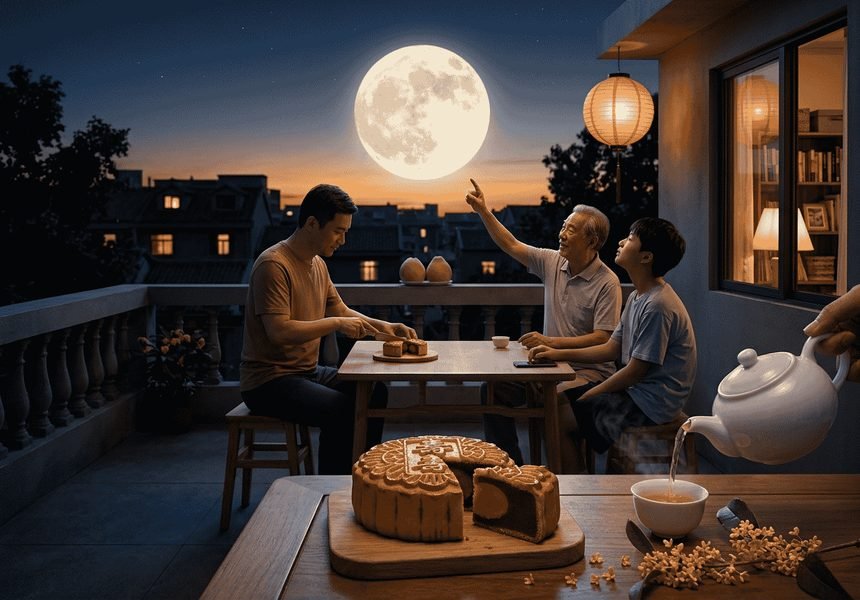
The first thing that hits you is the smell.
Not the food — not yet. The smell of osmanthus. The tiny golden flowers that bloom in late September and early October, their scent drifting through every open window, sweet and faintly lemony, the way autumn itself would smell if autumn had a perfume.
Then you look up. And there it is. The fullest, brightest moon of the year.
This is 中秋节 (Zhōngqiū Jié) — the Mid-Autumn Festival, sometimes called the Moon Festival in English. The fifteenth day of the eighth lunar month, landing in September or early October. It ranks second only to Spring Festival in the Chinese calendar, and for many people, it’s the one they look forward to most. Less frantic than Chinese New Year. Less formal. Just one perfect night. The moon at its peak. The family around a table. A box of mooncakes open between them.
Behind the mooncakes and the moonlight, though, there’s an older story. A woman who lives on the moon. A rabbit who pounds medicine. And a poem that has been keeping people company on autumn nights for nearly a thousand years.
The story goes like this.
A long time ago, ten suns burned in the sky at once, scorching the earth. An archer named 后羿 (Hòu Yì) shot down nine of them, saving the world. As a reward, the Queen Mother of the West gave him an elixir of immortality — enough for two people, meant to be shared with his wife.
His wife was 嫦娥 (Cháng’é).
A jealous apprentice tried to steal the elixir. To keep it from falling into the wrong hands, Chang’e drank it herself. Immediately, she began to float. Higher and higher. She couldn’t stop. She drifted all the way to the moon, where she landed in a cold, silent palace — the 月宫 (Yuègōng), the Lunar Palace.
And there she has stayed ever since.
Depending on who tells the story, this is tragic or bittersweet or both. Chang’e became immortal, but at the cost of being separated forever from the man she loved. On Mid-Autumn night, when the moon is fullest, Hou Yi would set out her favorite foods in the garden — mooncakes, fruit — and gaze up at the moon, hoping she could see him too.
She’s not entirely alone up there. A 玉兔 (Yùtù) — a Jade Rabbit — keeps her company, endlessly pounding herbs into an elixir with a mortar and pestle. On a very clear night, children will tell you, you can see the rabbit’s silhouette on the moon’s surface.
Chang’e has become something larger than a character in a myth. She’s the ache of distance. The face of everyone who’s ever been separated from someone they love, looking at the same moon and hoping it carries the message.
If you only know one thing about Mid-Autumn Festival, it’s probably the mooncake.
月饼 (Yuèbǐng) are dense, round pastries, about the size of your palm, pressed with intricate patterns on top: characters for longevity or harmony, flowers, the name of the bakery. They’re round because the moon is round. And roundness in Chinese culture means 团圆 (tuányuán) — reunion, completeness, family coming full circle.
What’s inside depends on where you are:
A mooncake is not something you eat alone. You slice it into wedges — like a small cake, like a pizza, and everyone at the table takes a piece. One mooncake. Shared. The slicing itself is the ritual. You don’t eat a mooncake. You participate in it.
For twelve lunar months, the moon does its thing. Waxing, waning, the usual. But on the fifteenth night of the eighth month, it reaches peak fullness.
Chinese families set up a table outdoors — on a balcony, in a courtyard, on a rooftop — and arrange an offering: mooncakes, pomelos, a pot of tea. Someone lights a stick of incense. And then everyone sits and does something that sounds simple but feels increasingly rare in modern life: they look up.
赏月 (Shǎngyuè) — appreciating the moon. Gazing at it. Not just glancing.
There’s no agenda during shangyue. You’re not eating. You’re not talking. You’re just watching the moon rise, brighter than it’s been all year, so bright it casts shadows, so clear you can trace the dark patches on its surface. And something happens when you’re all looking at the same thing. The conversation slows. The phones go away. The distance between people shrinks.
For those who can’t make it home — and there are millions of them every year — the moon becomes a kind of shared screen. You know that somewhere, hundreds of kilometers away, your parents are looking at the same moon. It’s not the same as being there. But it’s not nothing.
In 1076, the poet 苏轼 (Sū Shì) was away from home during Mid-Autumn. He had been drinking. He missed his brother. He looked at the moon and wrote a poem called 《水调歌头》 (Shuǐ Diào Gē Tóu) — “Prelude to Water Melody.”
It’s one of the most famous poems in the Chinese language. And the last two lines are the ones that have outlived dynasties:
但愿人长久,千里共婵娟。
Dàn yuàn rén chángjiǔ, qiānlǐ gòng chánjuān.
May we both be blessed with long life — though a thousand miles apart, we share the beauty of this moon together.
That’s it. That’s the whole festival in two lines. You can’t always be in the same place as the people you love. The moon doesn’t fix that. But it makes the distance feel less empty. Someone you love is under this moon too. Looking up. Maybe at the same moment.
Su Shi wrote that line drunk and homesick in the 11th century, and people still quote it every Mid-Autumn. A thousand years is a long time for a poem to stay alive. It stays alive because the feeling it names hasn’t gone anywhere.
Mid-Autumn doesn’t have the noise of Spring Festival. No firecrackers. No door-to-door visits. It’s quiet. One evening. A box of pastries. A pot of tea. The moon.
And maybe that’s why it works. It doesn’t ask much of you. It just asks you to show up, eat something round, and look at the sky for a while.
Underneath the mooncakes and the myth and the poetry, what the festival actually wants you to feel is this: you belong to people. You belong to a family, a history, a chain of hands that have been opening mooncake boxes and telling the Chang’e story and reciting Su Shi’s lines for centuries. You are part of that, whether you’re at the table or a thousand miles away.
The moon doesn’t check your ticket. It’s just there. Fullest on this one night. Waiting.
This is the festival our students at TutorHan remember long after the vocabulary quiz is over.
Beginner / Intermediate: Is there a celestial body — the moon, the sun, a particular star — that carries special meaning in your culture? What does it symbolize?
Advanced / Heritage learners: Modern mooncakes now come in flavors like matcha, durian, and even ice cream. Some people say this is innovation. Others say it’s losing tradition. Where would you draw the line between honoring a tradition and letting it evolve?
What would you put inside your ideal mooncake? Tell us in the comments — savory or sweet, traditional or something entirely new.
 June 20, 2026
 June 17, 2026
 June 14, 2026

High-efficiency, scenario-based Chinese learning for overseas adults. Master Business Chinese, ace HSK, or build oral fluency — on your schedule.
© 2026 TutorHan Chinese. All rights reserved.