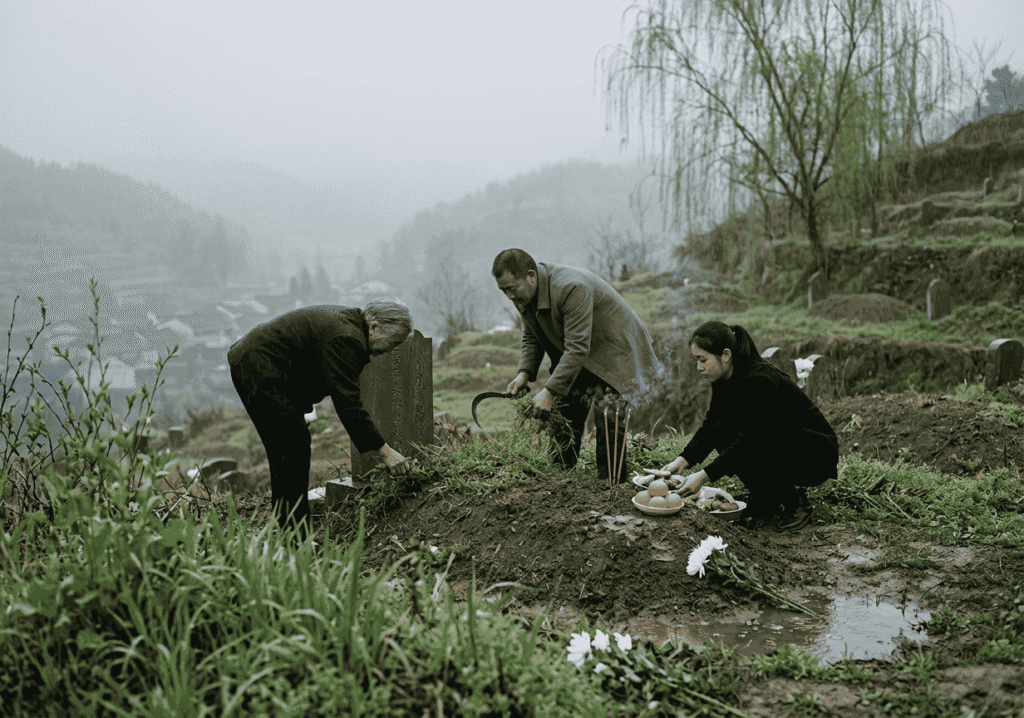
You notice the rain first.
Not a storm. Nothing dramatic. Just a steady, gray drizzle that starts sometime before dawn and doesn’t quite stop until evening. The kind of rain that soaks into the soil and releases the smell of wet grass and turned earth. The kind of rain that makes the world feel hushed.
In Chinese, there’s a word for when the weather and the mood line up this precisely: 应景 (yìngjǐng). A perfect match between the occasion and the atmosphere.
If any day on the Chinese calendar is yingjing, it’s 清明节 (Qīngmíngjié) — Qingming Festival, also known in English as Tomb Sweeping Day. It falls around April 4th to 6th each year. The air is damp. The willows are starting to green. And millions of Chinese families make their way to cemeteries and hillside graves, carrying flowers, food, and paper money.
To an outsider, the idea of a “tomb sweeping” holiday might sound morbid. It’s not. Qingming is the most emotionally complex day in the Chinese year — grief and spring renewal folded into the same moment. A day when the dead are remembered and the living are reminded to live.
Qingming didn’t start as a tomb sweeping day. It started as a solar term — one of twenty-four points on the ancient Chinese agricultural calendar, marking the moment when the weather turns clear and warm enough for spring planting. The characters 清明 literally mean “clear and bright.”
The tomb sweeping part came later, borrowed from an older festival called 寒食节 (Hánshíjié) — the Cold Food Festival.
The story goes like this. Sometime around the 7th century BC, a nobleman named Chong’er was forced into exile. One of his most loyal followers, a man named 介子推 (Jiè Zǐtuī), once cut a piece of flesh from his own thigh to make soup for the starving prince. Years later, Chong’er returned to power as Duke Wen of Jin. He rewarded everyone who had helped him — except Jie Zitui, who had retreated to live in the mountains with his mother, uninterested in politics.
When the duke finally tried to summon him, Jie refused to come down. The duke, in a spectacularly bad decision, ordered the mountain set on fire to force him out. Jie and his mother burned to death.
Grief-stricken, the duke decreed that no fires could be lit on the anniversary of Jie’s death. For one day each year, everyone ate cold food.
Over centuries, the Cold Food Festival and the Qingming solar term merged. By the Tang and Song dynasties, what emerged was a single occasion that combined the restraint of Cold Food with the grave-visiting rituals of Qingming. One day. Two emotional registers. Cold ashes and fresh green shoots.
Here’s what Qingming actually looks like on the ground.
A family — sometimes a dozen people, sometimes three generations — walks up a hillside path between terraced graves. The weeds have grown since last year. Someone takes out a sickle and cuts them back. Someone else piles fresh earth onto the grave mound, patting it firm. This is 上坟 (shàngfén) and 扫墓 (sǎomù) — visiting the grave, sweeping the tomb.
It’s physical work. It’s supposed to be. You’re tending the house of your ancestors the way you’d tend the house of a living relative. The weeds cleared, the earth repaired, the headstone wiped clean.
Then comes the offering. Bowls of food — a whole cooked chicken, a cut of pork, oranges, rice wine — are arranged in front of the gravestone. Incense sticks are lit and planted in the earth, thin lines of smoke curling upward.
And then the 纸钱 (zhǐqián) — paper money. Stacks of it, printed to look like traditional Chinese currency or gold ingots. Sometimes paper versions of modern things: a car, a phone, a house. All of it goes into the fire.
I know how this looks from the outside. It’s easy to dismiss as superstition. But if you’ve ever stood next to someone while they burned paper money for a parent, you’d understand it differently. It’s not about believing that the dead literally receive these things. It’s about doing something. When someone you love is gone, the hardest part is not being able to do anything for them anymore. Ritual gives you something to do. It fills your hands.
There’s a Chinese phrase for this: 事死如事生 (shì sǐ rú shì shēng) — serve the dead as you served the living. The point isn’t the paper. The point is the moment you spend thinking about them.
Something else happens around Qingming that people don’t talk about as openly.
梦见逝去的亲人 (mèngjiàn shìqù de qīnrén) — dreaming of departed loved ones.
It’s more common than people admit. Ask anyone whose parent or grandparent has passed, and they’ll likely tell you they dreamed about them in the days around Qingming. Whether it’s the mind’s response to the season — you know it’s tomb sweeping time, so your thoughts turn toward them — or something less rational, doesn’t really matter. What matters is that people experience it as a visit.
In Chinese folk belief, dreams are one of the ways the two worlds stay connected. A dream of a deceased parent asking for a blanket might prompt the family to burn a paper blanket at the grave. A dream where Grandma looks content and says nothing is taken as a quiet reassurance.
These dreams aren’t frightening. They’re mostly soft. Someone cooking. Someone sitting in a familiar chair. Someone at the edge of a room, just watching. The feeling afterward isn’t fear. It’s the ache of having seen them, and the strange comfort of having seen them at all.
No discussion of Qingming works without its most famous poem.
During the Tang Dynasty, the poet 杜牧 (Dù Mù) wrote four short lines that every Chinese schoolchild still memorizes:
清明时节雨纷纷,路上行人欲断魂。
Qīngmíng shíjié yǔ fēnfēn, lùshàng xíngrén yù duànhún.
A rough English rendering:
In Qingming season, the rain falls without end,
and travelers on the road feel their hearts about to break.
Twenty-eight characters. No metaphor, no allusion, no clever wordplay. Just rain. A road. A person falling apart inside.
That’s the grief side of Qingming. The poet captures it without dramatizing — the rain is just rain, the road is just a road, and somehow the combination is devastating.
But here’s what people often forget: Du Mu’s poem doesn’t end in despair. The second couplet takes a turn:
借问酒家何处有,牧童遥指杏花村。
Jièwèn jiǔjiā héchù yǒu, mùtóng yáo zhǐ xìnghuā cūn.
“Excuse me, where can I find a tavern?”
A shepherd boy points — far off, to Apricot Blossom Village.
After the sorrow, a drink. After the tears, the warmth of a tavern. This is classic Chinese emotional logic. You don’t escape grief. You move through it and out the other side. The same rain that soaks your clothes at the graveside also waters the apricot blossoms.
If you’ve spent any time in eastern China in early April, you know: it rains. Almost every year.
There’s a meteorological reason. Qingming falls at the start of the spring rainy season, when warm moist air from the south meets lingering cold air from the north. The result is day after day of gray drizzle.
But the Chinese cultural imagination has turned this coincidence of climate into something more meaningful. The rain isn’t just weather. It’s the sky weeping alongside the mourners. Heaven sharing the load.
应景 (yìngjǐng) — that word again. When the external world mirrors the internal one so perfectly, the boundary between the two goes soft. You’re not in the rain feeling sad. You’re in a world that is sad with you.
This shared sorrow, distributed across the entire landscape, is what makes Qingming’s sadness bearable. Your grief isn’t private. It’s weather. It’s seasonal. It will pass.
Like every Chinese festival touched by urbanization, Qingming is shifting.
The cities can’t handle the smoke. In Beijing, Shanghai, and other large cities, open burning of paper money has been restricted. Many cemeteries now provide designated burning zones or communal fire pits. Some families skip the burning entirely and leave flowers instead — chrysanthemums, mostly, which in Chinese culture are associated with mourning.
The distance is real. Hundreds of millions of Chinese live far from their ancestral hometowns. Going home to sweep the graves isn’t always possible. In response, a new phenomenon has emerged: online tomb sweeping. Websites and apps where you can light a virtual candle, leave a virtual offering, and type a message to the departed. It sounds hollow, I know. But for a young professional in Shenzhen whose grandparents’ graves are in a village two thousand kilometers away, it’s something.
The forms shift. The need doesn’t. What persists, through every iteration of Qingming — from Tang Dynasty poetry to WeChat tomb sweeping — is the simple impulse to remember. To carve out one day when the dead are given their due.
Here’s the part I find myself thinking about.
At a Qingming grave, you’re not just remembering a person. You’re standing in a line. Your grandfather told you stories about his grandfather, who told stories about his. Now it’s your turn. Now a younger cousin or a niece is watching you light incense and asking what it means.
This is 传承 (chuánchéng) — intergenerational transmission. It’s how families remember who they are.
And there’s another layer. Standing at a graveside, looking at the name carved in stone, you can’t help doing a certain kind of math. This person had X years. I’ve had Y. How am I spending them?
This isn’t morbid. It’s clarifying. Qingming strips away the noise — the deadlines, the notifications, the small anxieties — and asks the only question that actually matters: are you living in a way that honors what you were given?
The Chinese phrase is 珍惜生活 (zhēnxī shēnghuó) — cherish life. Not in the abstract. Right now. Today. While you’re still on the living side of the incense smoke.
For Chinese learners thinking about this topic:
Beginner / Intermediate: In your culture, what flowers or objects are associated with mourning? Are there specific days when families visit graves or memorials?
Advanced / Heritage learners: Du Mu’s Qingming poem is over 1,200 years old, yet Chinese people still quote it every April. Why do you think certain poems survive so long in cultural memory? What makes a piece of writing “immortal” in your view?
Is there someone you remember especially clearly this time of year? Leave a comment — we’d be honored to read about them.
 June 20, 2026
 June 17, 2026
 June 14, 2026

High-efficiency, scenario-based Chinese learning for overseas adults. Master Business Chinese, ace HSK, or build oral fluency — on your schedule.
© 2026 TutorHan Chinese. All rights reserved.