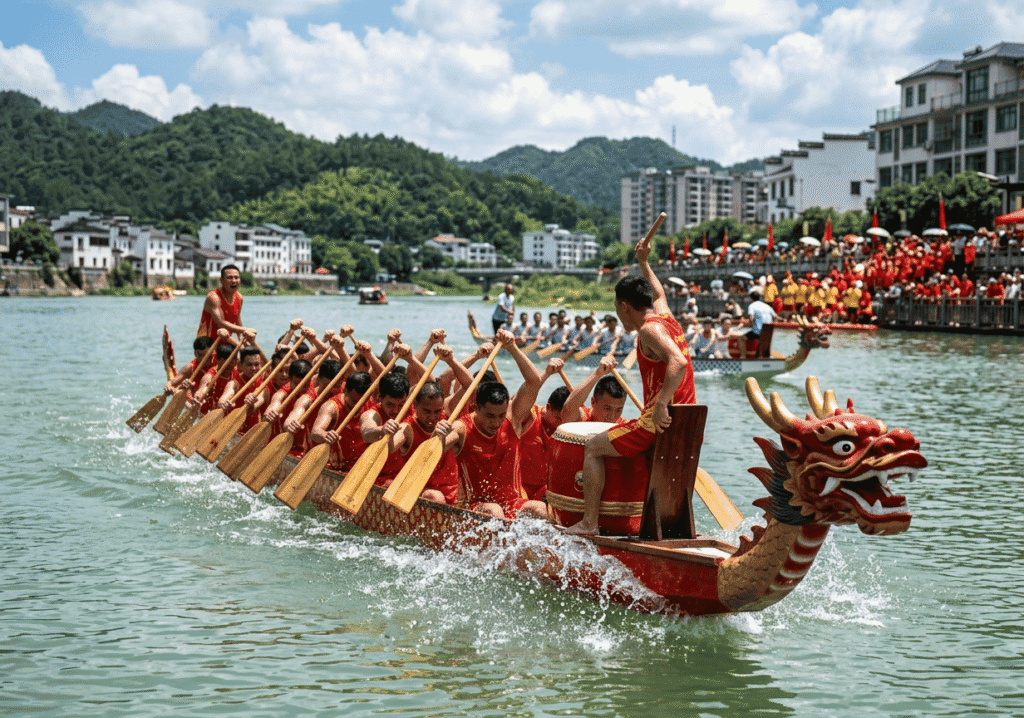
You hear the drums before you see the boats.
Thump. Thump-thump. Thump-thump-thump.
The rhythm carries across the water, sharp and urgent, like a heartbeat amplified. Then the boats come into view — long and narrow, painted in reds and golds, a carved dragon head snarling at the prow. Twenty paddlers moving as one body. A drummer at the front, sweat dripping, setting the pace. A helmsman at the back, steering with a wooden oar.
On the riverbank, families press forward, shouting. Someone unwraps a steaming bundle of bamboo leaves and the smell of sticky rice and pork fat drifts through the crowd.
This is 端午节 (Duānwǔ Jié) — the Dragon Boat Festival. The fifth day of the fifth lunar month, usually landing in June. And if you’re anywhere near a river in China, Hong Kong, Taiwan, or Southeast Asia on this day, you’ll know it.
But behind the drums and the dumplings is a much older story. A story about a poet. A story about what you do when your country is falling apart and nobody will listen.
The year is 278 BC. The kingdom of Chu is being devoured by its neighbor, the Qin. A man named 屈原 (Qū Yuán) — aristocrat, advisor, one of the finest poets China has ever produced — has been exiled.
Qu Yuan had spent years warning his king about the threat from Qin. He proposed alliances. He pushed for military reform. The king didn’t listen. Worse, rival ministers, jealous of Qu Yuan’s influence, convinced the king that Qu Yuan was a traitor. He was stripped of his position and banished to the countryside.
For years, Qu Yuan wandered, writing some of the most devastating poetry in the Chinese language. In his masterpiece 《离骚》(Lí Sāo) — “Encountering Sorrow” — he wrote a line that Chinese schoolchildren still memorize:
路曼曼其修远兮,吾将上下而求索。
Lù mànmàn qí xiū yuǎn xī, wú jiāng shàngxià ér qiúsuǒ.
The way is long and distant — I will search high and low.
He was talking about the pursuit of truth. About refusing to compromise, even when compromise would have saved his career. About walking a long road alone because the short, easy road wasn’t right.
In 278 BC, Qin forces captured the Chu capital. Qu Yuan, by then in his sixties, walked to the Miluo River (汨罗江, Mìluó Jiāng) and drowned himself.
He wasn’t just mourning his kingdom. He was making a statement with his body — the final, irreversible form of political dissent. If words couldn’t reach the king, maybe this would.
The local people, who had known and respected Qu Yuan, rushed to the river in boats. They beat drums to scare away fish and evil spirits. They threw packets of rice into the water so the fish would eat the rice instead of his body. Or so the story goes.
Whether literally true or not barely matters. What matters is that the story survived 2,300 years, and millions of people still act it out every June.
Dragon boat racing today is loud, sweaty, and spectacular.
The boats themselves are works of craft — slender teak hulls that seat twenty-two people, with the carved dragon head and tail attached only for races and festivals. Before a race, a Taoist priest or community elder performs an “awakening the dragon” ceremony, dotting red paint on the dragon’s eyes to bring the boat to symbolic life.
The crew breaks down like this:
When it works, it’s hypnotic. Twenty paddles hitting the water at the exact same instant. The boat lifts slightly. The stroke rate climbs from sixty to eighty to a hundred per minute. The drummer goes harder. The coxswain at the back screams. The shoreline blurs.
Dragon boat racing is a team sport in the most extreme sense. One paddler out of sync doesn’t just slow the boat — they create drag that everyone else has to fight. You either move as one or you don’t move at all.
This is why companies, universities, and expat communities across China field their own teams. The dragon boat isn’t just a relic — it’s an active, living sport. There are World Championships now. Teams from Canada, Australia, Germany, the Philippines. A two-thousand-year-old Chinese folk ritual has gone global.
On the morning of Duanwu, before the races start, every Chinese kitchen worth its salt smells like bamboo leaves.
粽子 (Zòngzi) — glutinous rice dumplings wrapped in bamboo or reed leaves — are the food of Dragon Boat Festival. Making them is a whole operation.
First, the leaves. Dried bamboo leaves soaked overnight until pliable. Then the rice — short-grain glutinous rice, the sticky kind, also soaked for hours. Then the filling. This is where regional loyalties kick in:
The wrapping is the skill part. You fold the leaf into a cone, pack in rice and filling, fold the leaf over, and tie it with kitchen string or reed strips. Too loose and water seeps in during boiling, making the rice mushy. Too tight and the rice can’t expand, coming out dense and undercooked. Every family has a grandma who gets it exactly right and shakes her head at everyone else’s.
The wrapped bundles boil for two to three hours. When you unwrap one, the rice has absorbed the fragrance of the leaf — a grassy, almost tea-like scent that you can’t get from any other cooking method. The filling has rendered its fat into the surrounding rice. You eat it standing up in the kitchen, burning your fingers, because nobody can wait.
The story says this began as fish food — the rice packets thrown into the Miluo River so Qu Yuan’s body would be left alone. But food rituals outlive their origin stories. Zongzi aren’t about death anymore. They’re about the first week of June, about your mom calling to ask if you’ve eaten, about the rhythm of the year turning.
There’s another layer to Duanwu that the dragon boats and zongzi tend to overshadow.
The fifth lunar month is the start of summer. In ancient China, this was considered a dangerous time — the heat brought venomous insects, snakes, and disease. Duanwu was partly a protective ritual. A way to armor yourself and your household against the season’s dangers.
A few things you’d see in a traditional Duanwu household:
艾草 (Àicǎo) — mugwort. Bundles of silvery-green mugwort hung above the front door, sometimes alongside 菖蒲 (chāngpú) — calamus. Both plants are aromatic and were believed to repel insects and evil influences. There’s a practical layer here: mugwort actually does have insect-repelling compounds.
雄黄酒 (Xiónghuáng jiǔ) — realgar wine. A yellow arsenic-sulfide mineral dissolved in rice wine. Adults would take a sip. Children, too young for it, would have a dot of the wine paste painted on their foreheads, often in the shape of the Chinese character 王 (wáng, “king”), mimicking the stripes on a tiger’s forehead — a symbol of protection.
香囊 (Xiāngnáng) — perfume sachets. Small embroidered pouches filled with dried herbs and spices, worn around the neck or tied to clothing. The embroidery patterns carry meanings: carp for abundance, lotus for purity, bats for good fortune.
五彩绳 (Wǔcǎi shéng) — five-color threads. Thin braided cords of red, yellow, blue, white, and black, tied around children’s wrists or ankles. They’re worn until the first rainfall after the festival, then tossed into a stream or river — symbolically washing away bad luck.
Some of these practices are fading in cities. But mugwort bundles still sell out at wet markets every Duanwu. And the five-color threads are having a quiet revival among younger parents who want their kids to know the old ways.
A 2,300-year-old suicide, a rice dumpling, a boat race in matching jerseys — on paper, none of it connects. And yet the festival holds.
I think it holds because each piece speaks to something real.
The Qu Yuan story isn’t really about one poet in 278 BC. It’s about the question of whether integrity matters when nobody’s watching. Whether standing for something, even when it costs you everything, leaves a mark that outlasts the people who pushed you out.
The dragon boats aren’t really about ancient search parties. They’re about what happens when twenty-two people synchronize — the moment when a collection of individuals becomes a single machine, and the machine is faster than any one person could be.
The zongzi aren’t really about fish food. They’re about your grandmother’s hands folding leaves. About the particular weight of a bamboo leaf in your palm. About food that only makes sense in a specific season, at a specific moment, with specific people.
And the charms — the mugwort, the sachets, the colored threads — are about a very old and very reasonable impulse. The world is full of things that can hurt you. Most of them are invisible. It’s not irrational to want protection. It’s human.
Beginner / Intermediate: In your country, are there foods that people only eat during specific festivals or seasons? What makes those foods feel special?
Advanced / Heritage learners: Qu Yuan is often described as a symbol of patriotism, but his story also involves speaking difficult truths to power and being punished for it. Do you think Qu Yuan would be considered a patriot or a dissident in modern terms — or are those the same thing?
Ever tried making zongzi, or watched a dragon boat race? Tell us in the comments — we’d love to hear what you saw, or tasted.
 June 20, 2026
 June 17, 2026
 June 14, 2026

High-efficiency, scenario-based Chinese learning for overseas adults. Master Business Chinese, ace HSK, or build oral fluency — on your schedule.
© 2026 TutorHan Chinese. All rights reserved.